Why is Everyone So Bloody Miserable at Work? By John Caldwell, CEO RWR Group

RWR Group Marketing • May 11, 2025

We’re in the thick of it right now—big change, big growth, and even bigger expectations.

New leadership. New systems. New people. The kind of momentum we’ve been chasing for years is finally happening. And yet, if I’m being honest, the one thing keeping me up at night isn’t the tech platforms, the strategy, or the P&L.

It’s our people.

I’ve been working hard to bring our team along for the ride—to keep them motivated, connected, and actually enjoying the work. But it’s not easy. In fact, it’s been one of the most confronting challenges of my career. Because despite our best efforts, I’ve started to notice something... and it’s not just in our business. It’s everywhere.

Lately, I’ve been walking through the city doing what I now jokingly call my “undercover investigative journalism” (a.k.a. eavesdropping). And here’s the thing: almost every single conversation I overhear is someone complaining about work.

Their job.
Their boss.
Their workload.
Their colleague.
Their life at work.

Not one positive work-related convo. Not even one. And I’ve been listening, properly listening, for weeks.
So naturally, it’s got me thinking:
What the hell is going on?
Why is no one content?

Is the workplace genuinely broken?
Is the grass actually greener, or is it just fertilised with everyone else’s burnout?
Are we all just carrying something heavier—and work’s become the easiest thing to blame?

The truth is, I don’t think it’s just the workplace. And I don’t think it’s just the people, either. I think we’re in a pressure cooker of change. Economically. Technologically. Culturally. And it’s spinning so fast, a lot of people feel like they’re falling behind or just can’t keep up.
So work cops the flack. Because it’s visible. It’s tangible. It’s where we spend most of our time. And let’s face it—it’s easier to blame your 9–5 than unpack the mess of uncertainty, fear, or personal stuff that might be sitting underneath it all.

As leaders, we do need to create safe, motivating workplaces where people can thrive. But it also makes me wonder: Are we expecting too much from our jobs? Are we asking work to fulfil every desire, validate our worth, and solve all our life problems?

Maybe the real question is this—
Are we unhappy at work…
Or just unhappy in general, and work is the nearest target?

Edina Monsoon (yes, from Absolutely Fabulous) once said:
"Cheer up world—it may bloody never happen."

Maybe she was onto something.
Maybe we all just need to breathe, reset, and remember that sometimes, perspective is the best productivity hack.

I don’t have all the answers—but I’m listening.

And if you’re leading people right now, I’d say keep listening too.

Because in this crazy, changing world, that might just be the most powerful thing any of us can do.
 

By RWR Group Marketing July 27, 2026
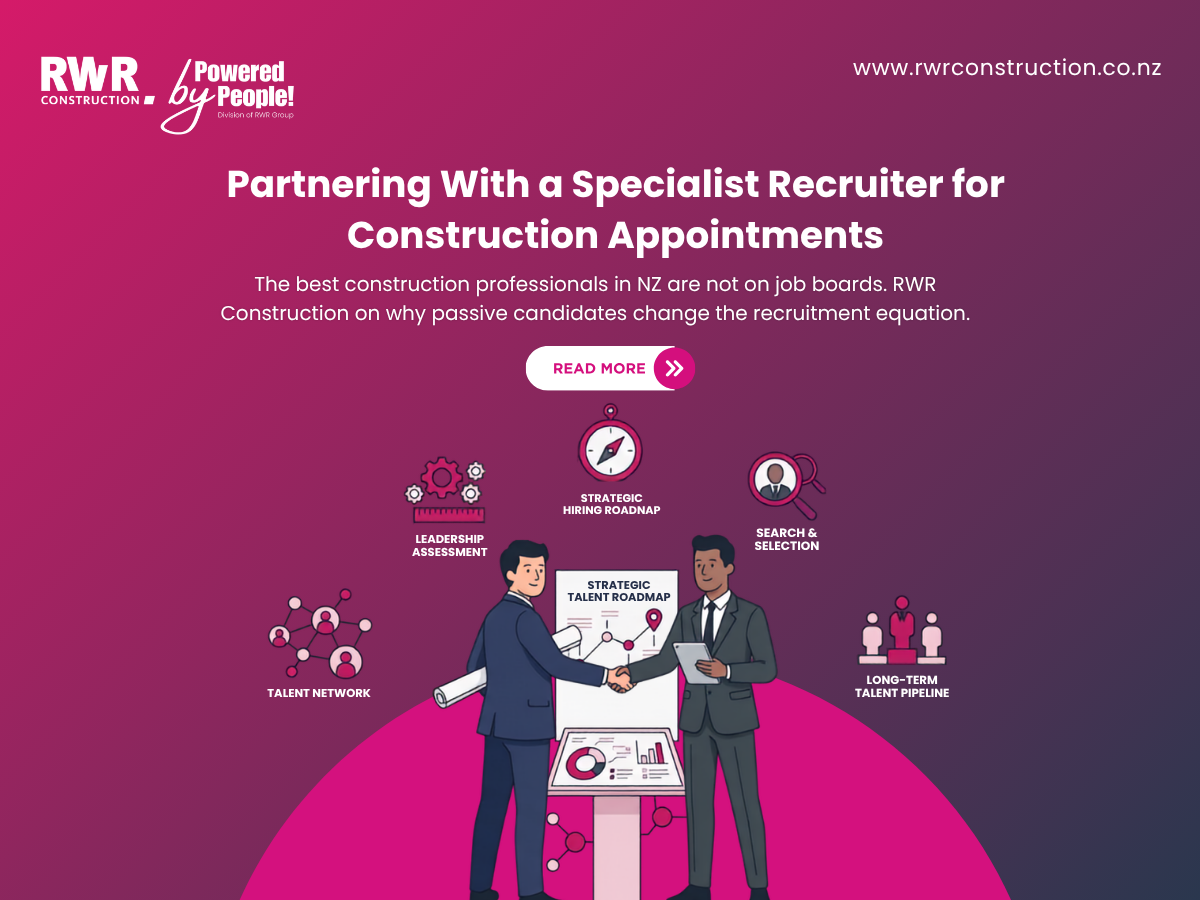
The best construction professionals in NZ are not on job boards. RWR Construction on why passive candidates change the recruitment equation.
By RWR Group Marketing July 20, 2026
Construction roles in NZ are taking longer to fill than ever. Here is why, and what employers can do about it.
By RWR Group Marketing July 14, 2026
Making the move from PM to Construction Director in NZ? Here is what employers are looking for and how to position yourself for the step up.
By RWR Group Marketing June 10, 2026
What do top construction candidates say about working for you? Your employment brand is already out there. Here is how to own it.
By RWR Group Marketing May 14, 2026
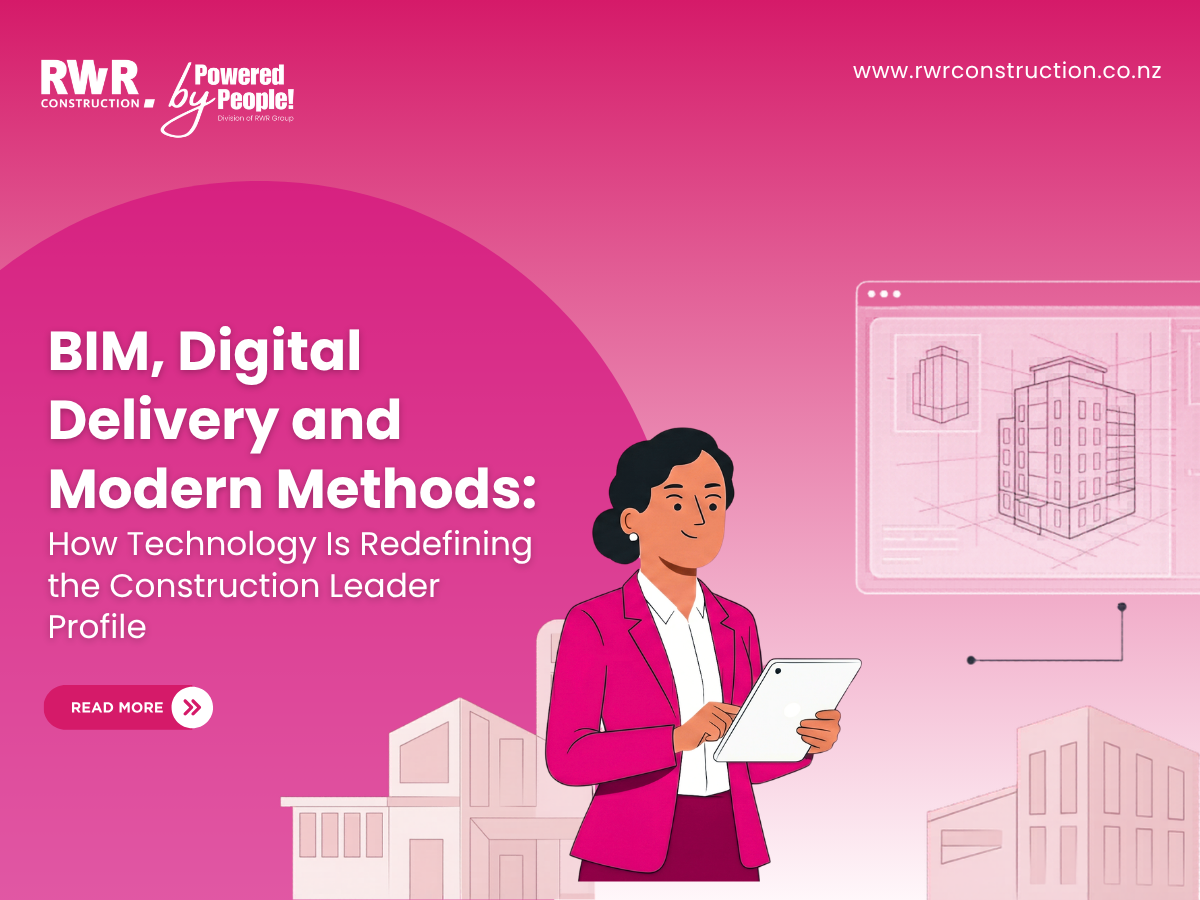
BIM, digital delivery and modern methods are reshaping what employers expect from construction leaders. Here's what senior professionals need to know.
By RWR Group Marketing May 7, 2026
Thinking about crossing the Tasman for a construction role? Here's what senior NZ construction professionals need to know before they make the move.
By RWR Group Marketing May 1, 2026
In New Zealand construction, hiring needs are shifting as more professionals move between residential and infrastructure projects. While both sectors rely on skilled trades and strong site leadership, the expectations, scale and risk profiles are fundamentally different. Hiring managers who apply the same recruitment approach across both markets often face mismatches, slower onboarding and higher turnover. Understanding the differences is essential for building reliable project teams. Why residential hiring instincts can fail in infrastructure environments Residential construction hiring often prioritises speed, versatility and hands-on problem solving. Candidates are typically expected to move quickly between tasks and adapt to smaller, more fluid teams. Infrastructure roles operate differently. They require structured planning, compliance awareness and the ability to work within layered stakeholder environments. Candidates who thrive in residential settings may struggle with documentation-heavy or process-driven infrastructure projects. When infrastructure candidates expect more structure than residential roles provide Infrastructure professionals are used to clearly defined scopes, reporting lines and regulatory frameworks. When placed into residential environments without that structure, they can experience frustration or disengagement. This mismatch often leads to early exits or underperformance. Clear alignment of expectations is critical before placement. Why speed of hiring means different things in each sector In residential construction, speed is often a competitive advantage. Projects move quickly and hiring decisions are frequently made under time pressure. Infrastructure hiring prioritises accuracy over speed. Compliance checks, safety requirements and long-term project alignment can extend timelines. Rushing this process can lead to costly mis-hires or onboarding delays. Practical checklist for hiring across both construction markets ☐ Define whether the role sits in residential, infrastructure or a hybrid environment ☐ Align job descriptions with the actual project structure and reporting lines ☐ Clarify compliance and certification requirements early in the process ☐ Assess candidates based on sector-specific experience, not general capability alone ☐ Set expectations around pace, documentation and stakeholder involvement 3 hiring adjustments that improve outcomes across both sectors ☐ Separate competency requirements for residential and infrastructure roles instead of using a generic job profile ☐ Adjust interview questions to reflect real site conditions such as compliance demands or project scale ☐ Involve operational leaders from the relevant sector in final hiring decisions Aligning Hiring Strategy With Sector Reality In New Zealand Construction The New Zealand construction market continues to evolve, with many professionals moving between residential builds and large-scale infrastructure projects. However, success in one does not automatically translate to success in the other. Hiring strategies that recognise these differences are more likely to deliver stable teams, stronger project delivery and reduced turnover. RWR Construction supports employers across New Zealand in identifying the right talent for the right environment, ensuring hiring decisions reflect the realities of each sector. Reach out to our team if you want targeted construction recruitment support that can improve your hiring outcomes: Contact Us page . Effective hiring in construction is not about using one consistent playbook. It is about adapting the approach to match the complexity and demands of each project type.
By RWR Group Marketing April 6, 2026
Commercial discipline is reshaping construction recruitment in New Zealand, with employers seeking candidates who demonstrate strong cost awareness, accountability and the ability to deliver long-term project value.
By RWR Group Marketing March 27, 2026
New Zealand’s construction sector is entering a period of cautious recovery. Activity is finally stabilising, particularly across infrastructure and essential housing projects. But here’s the key shift: while project pipelines are returning, skilled talent remains in short supply. This trend isn’t isolated. Australia is experiencing similar conditions, with strong demand for infrastructure and commercial builds placing pressure on an already stretched workforce. For employers across both markets, recruitment is no longer just reactive. Why This Matters As projects ramp up, competition for experienced professionals such as site managers, project managers and skilled trades is intensifying. Businesses that fail to adapt their hiring approach risk project delays, higher costs and burnout within existing teams. 3 Tips to Stay Competitive in Construction Hiring 1. Move Faster Than the Market Top candidates are off the market in a matter of days. Streamline your hiring process to secure talent before competitors do. 2. Offer More Than Just Salary Flexibility, project stability, and career progression are becoming key decision drivers, especially for passive candidates. 3. Think Trans-Tasman With skill shortages in both countries, broadening your search across Australia and New Zealand can unlock new talent pools. Practical Recruitment Checklist ☐ Clear pipeline visibility (6–12 months ahead) ☐ Defined role requirements and timelines ☐ Competitive, up-to-date salary benchmarking ☐ Strong employer value proposition ☐ Efficient interview and decision-making process ☐ Access to passive candidate networks ☐ Workforce retention strategy in place Take Action 1. Review Your Workforce Plan Assess upcoming projects and identify talent gaps early. Waiting until a role is urgent will limit your options. 2. Partner with a Specialist Recruiter Engage experts who understand the construction market and have access to pre-qualified candidates across both New Zealand and Australia. Key Takeaway The construction market is recovering, but the talent shortage hasn’t gone away. Companies that plan ahead, move quickly and position themselves as employers of choice will secure the people they need to deliver projects successfully. Ready to Strengthen Your Team? Scaling up for new projects? Do you need help to replace critical roles? Our team can help you find the right people fast. RWR Construction connects businesses with high-quality construction talent across New Zealand.  Check out these pages on our website for more current talent insights, market updates and recruitment solutions designed to keep your projects moving: Insights
By RWR Group Marketing March 19, 2026
In a tight labour market, strong leadership is the key to reducing hiring risk and building resilient teams. Discover how effective leaders improve recruitment outcomes, retention and long-term business success.