Our View: The Best Hiring Outcomes Come From Clear Role Briefs

RWR Group Marketing • August 17, 2026

When a critical position opens up within a contractor, consultancy or residential development firm, the commercial pressure to fill it is immediate.


Every week a project director, senior engineer or commercial manager role sits empty, risk profile increases and program momentum stalls. Under this pressure, many hiring managers make a costly mistake. They dust off a generic, five-year-old job description, send it out to multiple agencies and hope for the best.


The result is inevitable: a flood of mismatched CVs, wasted interview hours and extended vacancy timelines. At RWR Construction, our view is simple. The best hiring outcomes come from clear, highly calibrated role briefs.

How to Build a Bulletproof Role Brief

Securing talent requires moving past basic task checklists. To build a brief that actually attracts commercial performers, structure your specification around these three pillars:

  1. Define the Commercial Objective: Move past what the person will do daily. Focus on what they must deliver. Are they navigating a specific contract dispute, turning around an underperforming civil site or expanding a design team?
  2. Isolate the Cultural Reality: Be honest about the workplace environment. State whether the position requires a hands-on supervisor who thrives in the mud or a highly strategic director who can manage complex client politics.
  3. Establish Clear Accountability: Outline the exact financial thresholds, pipeline volumes and headcount ownership this leader will control from day one.


When you invest the time to build a sharp, unambiguous brief, you stop chasing numbers and start attracting precision. You provide your recruitment partner with the exact blueprint required to target, headhunt and secure the top passive talent your competitors cannot reach.


Get Your Hiring Back on Track

A precise role brief streamlines your recruitment pipeline, protects your project margins and ensures long term retention. If you are tired of filtering through generic resumes that do not fit your business reality, it is time to change your approach.


Contact our specialist team at RWR Construction today to get expert help in hiring your next high-performance leader.
By RWR Group Marketing August 10, 2026
Discover why capability beats out basic tenure when recruiting construction and engineering leaders in New Zealand.
By RWR Group Marketing August 3, 2026
Learn how to position yourself for permanent construction and engineering management roles earning $100k to $400k+ in New Zealand.
By RWR Group Marketing July 29, 2026
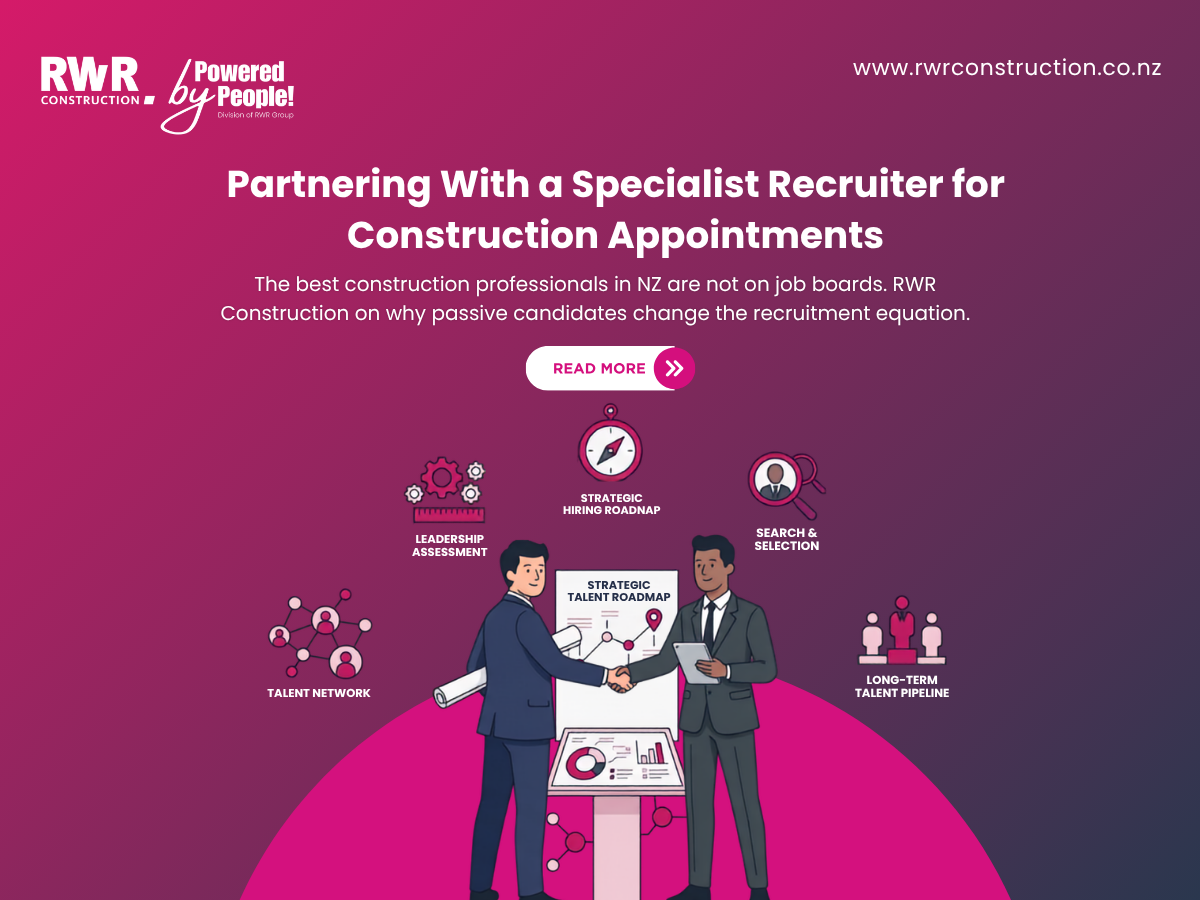
What to look for in a specialist construction recruiter in NZ. How the right recruitment partner changes outcomes for senior and executive appointments.
By RWR Group Marketing July 27, 2026
The best construction professionals in NZ are not on job boards. RWR Construction on why passive candidates change the recruitment equation.
By RWR Group Marketing July 20, 2026
Construction roles in NZ are taking longer to fill than ever. Here is why, and what employers can do about it.
By RWR Group Marketing July 14, 2026
Making the move from PM to Construction Director in NZ? Here is what employers are looking for and how to position yourself for the step up.
By RWR Group Marketing June 10, 2026
What do top construction candidates say about working for you? Your employment brand is already out there. Here is how to own it.
By RWR Group Marketing May 14, 2026
BIM, digital delivery and modern methods are reshaping what employers expect from construction leaders. Here's what senior professionals need to know.
By RWR Group Marketing May 7, 2026
Thinking about crossing the Tasman for a construction role? Here's what senior NZ construction professionals need to know before they make the move.
By RWR Group Marketing May 1, 2026
In New Zealand construction, hiring needs are shifting as more professionals move between residential and infrastructure projects. While both sectors rely on skilled trades and strong site leadership, the expectations, scale and risk profiles are fundamentally different. Hiring managers who apply the same recruitment approach across both markets often face mismatches, slower onboarding and higher turnover. Understanding the differences is essential for building reliable project teams. Why residential hiring instincts can fail in infrastructure environments Residential construction hiring often prioritises speed, versatility and hands-on problem solving. Candidates are typically expected to move quickly between tasks and adapt to smaller, more fluid teams. Infrastructure roles operate differently. They require structured planning, compliance awareness and the ability to work within layered stakeholder environments. Candidates who thrive in residential settings may struggle with documentation-heavy or process-driven infrastructure projects. When infrastructure candidates expect more structure than residential roles provide Infrastructure professionals are used to clearly defined scopes, reporting lines and regulatory frameworks. When placed into residential environments without that structure, they can experience frustration or disengagement. This mismatch often leads to early exits or underperformance. Clear alignment of expectations is critical before placement. Why speed of hiring means different things in each sector In residential construction, speed is often a competitive advantage. Projects move quickly and hiring decisions are frequently made under time pressure. Infrastructure hiring prioritises accuracy over speed. Compliance checks, safety requirements and long-term project alignment can extend timelines. Rushing this process can lead to costly mis-hires or onboarding delays. Practical checklist for hiring across both construction markets ☐ Define whether the role sits in residential, infrastructure or a hybrid environment ☐ Align job descriptions with the actual project structure and reporting lines ☐ Clarify compliance and certification requirements early in the process ☐ Assess candidates based on sector-specific experience, not general capability alone ☐ Set expectations around pace, documentation and stakeholder involvement 3 hiring adjustments that improve outcomes across both sectors ☐ Separate competency requirements for residential and infrastructure roles instead of using a generic job profile ☐ Adjust interview questions to reflect real site conditions such as compliance demands or project scale ☐ Involve operational leaders from the relevant sector in final hiring decisions Aligning Hiring Strategy With Sector Reality In New Zealand Construction The New Zealand construction market continues to evolve, with many professionals moving between residential builds and large-scale infrastructure projects. However, success in one does not automatically translate to success in the other. Hiring strategies that recognise these differences are more likely to deliver stable teams, stronger project delivery and reduced turnover. RWR Construction supports employers across New Zealand in identifying the right talent for the right environment, ensuring hiring decisions reflect the realities of each sector. Reach out to our team if you want targeted construction recruitment support that can improve your hiring outcomes: Contact Us page . Effective hiring in construction is not about using one consistent playbook. It is about adapting the approach to match the complexity and demands of each project type.