The Calm Before the Scramble: What Shamubeel Eaqub’s Outlook Means for Construction Hiring

Ginny Ryder • April 3, 2025

We had the chance to sit in on the recent Trade Me breakfast event with Shamubeel Eaqub. If you haven’t come across him before, he’s one of New Zealand’s go-to economic commentators. Known for cutting through the noise with practical insights, Shamubeel has spent over 20 years making sense of complex economic shifts, writing books like Growing Apart and Generation Rent and regularly popping up in the media with straight-talking analysis.


Shamubeel gave a pretty honest take on what’s really happening behind the “recession” headlines. While it might feel like the market is on pause, most businesses aren’t letting people go, they’re simply replacing them. In his words, “We’re not seeing widespread redundancies. What’s happening is churn - and that churn is still hard to manage.”


At the same time, we’re seeing an uptick in business liquidations. Watching companies fold is never easy, especially when it affects people and livelihoods. But as Shamubeel pointed out, “a recession is like a reset button.” While painful, this period is also helping the sector recalibrate. Businesses that were operating on thin margins or shaky ground are being forced to take a hard look at their foundations, and that’s not all bad. Stronger businesses will emerge on the other side.


We are already seeing a gap between businesses with dedicated recruitment teams and those without. Internal teams are managing to fill roles. But for everyone else, hiring still feels slow and frustrating. We’re noticing that one of the ongoing challenges in the current market is timing. While recruitment processes are understandably cautious right now, delays can make it harder to secure top candidates. The reality is that strong applicants don’t tend to stay on the market for long, and by the time decisions are made, those individuals may have already accepted other offers. Even in a quieter market, good people are still being picked up quickly, which means moving too slowly can reduce your options.


Right now, many firms are playing it safe: holding back on new hires, watching cash flow, and waiting for things to settle. That caution is understandable, but it comes with risk. Shamubeel warned that “when the recovery comes, it’ll come quickly,” and those not ready to move could miss the boat.


What Candidates Actually Want (and What Employers Think They Want)

One of the standout insights from Shamubeel was around candidate motivators and the mismatch between what employers think people want versus what they’re actually looking for. Employers often assume that, in a tougher market, candidates are prioritising stability above all else. But Shamubeel pointed out that this just isn’t the case. What people really want is development, progression, and the chance to grow their careers. “There’s a gap,” he said, “between perceived and real motivators.” For construction businesses trying to attract or keep good people, it means shifting the focus, not just offering a secure role but showing what comes next, how someone can learn, and where they can go from there. Shamubeel also highlighted the importance of hiring for attributes as well as qualifications, things like adaptability, attitude, and cultural fit. Those people stick, grow, and add real value when the pressure’s on. Qualifications are less important in the long term than what hiring managers may think.


The Key Takeaway


Now is the time to act to get ahead of the curve. If you’re going to need people in the next 3–6 months, it pays to start thinking about it now. 


Construction projects live and die by the strength of the teams behind them. Waiting until the market “feels better” could mean missing out altogether, especially when demand picks up and supply is still tight.


We’re always happy to talk about what this looks like in real time. We’re deep in the market every day and see how this plays out across different parts of the construction sector. If it’s time to start thinking ahead, we’re here to share what we’re seeing and what’s working.
By RWR Group Marketing • September 27, 2026
Technical brilliance won't save a project if the relationships around it fall apart. That's the reality of leadership. Every major project in New Zealand runs on relationships. Clients, consultants, contractors and subcontractors all need to move in the same direction, often with different priorities and different pressures. Leadership at the top holds it together, or lets it fall apart. Here's what separates leaders who manage these relationships well from those who don't. Clarity over comfort Strong relationship managers don't avoid hard conversations. They have them early, clearly and respectfully. Leaders who dodge difficult topics to keep the peace tend to store up bigger problems for later. Look for candidates who can demonstrate direct, respectful communic ation under pressure. Genuine stakeholder management, not just reporting There's a big difference between updating a client and managing a client. The best understand what each stakeholder needs, not just what they say they need, and adjust their approach accordingly. That takes judgement, not just a status report template. Consistency across every relationship A leader who's warm with clients but dismissive with subcontractors is building a fragile network. Look for candidates who treat every relationship, client, consultant or contractor, with the same level of respect and professionalism. It shows up in team culture and in project outcomes. Commercial awareness in every conversation Every relationship in construction has a commercial dimension. Strong leaders understand this and negotiate accordingly, protecting margin and programme without damaging trust. Ask candidates how they've handled a commercial disagreement with a client or consultant. Their answer will reveal how they balance relationship and result. Proven conflict resolution Disagreements are inevitable on complex projects. What matters is how quickly and how well they get resolved. Ask for specific examples. A leader who can describe how they turned a tense client relationship around is showing you exactly what you need to see. Checklist for your next appointment ☐ Can they demonstrate clear communication under pressure? ☐ Have they genuinely managed stakeholders, not just reported to them? ☐ Are they consistent across every relationship type? ☐ Can they balance commercial outcomes with trust? ☐ Do they have an example of resolving conflict well? The strength of your leadership team shows up first in the strength of its relationships. At RWR Construction, we place permanent leaders across New Zealand's construction, engineering and infrastructure sectors who know how to manage every relationship a project depends on. Looking for a leader who can hold it all together? Visit www.rwrconstruction.co.nz/contact-us
By RWR Group Marketing • September 23, 2026
Your business today won't be the same in three years. So why hire leaders who can only handle where you are right now? Across New Zealand's construction, engineering and infrastructure sectors, growth is rarely steady. It comes in bursts: new contracts, new regions, new scale. The leaders you appoint today need to grow with that.. Here's what to look for when hiring for scale, not just for now Look past the current job description. Most businesses hire for the role in front of them. The smarter move is hiring for the role the business will need in eighteen months. Ask candidates how they'd approach the job if headcount doubled, or if the business moved into a new region. Their answer tells you more than their CV ever will. Test adaptability, not just experience Experience shows what someone has done. It doesn't show what they can do next. Look for leaders who've operated across different business sizes, structures or sectors. That range often predicts scalability better than years in a single role. Prioritise systems thinking Leaders who scale well think in systems, not just tasks. They build processes that don't rely on them being in the room. Ask candidates how they've set up teams, reporting lines or handover processes in past roles. If they can only describe their own workload, that's a red flag. Look for people who build people A leader who can scale with your business is one who grows other leaders underneath them. Ask about who they've mentored, promoted or backed. A strong bench is one of the clearest signs of leadership built for growth. Assess how they handle ambiguity Growing businesses rarely have everything mapped out. Leaders who need certainty before they act will slow you down exactly when you need speed. Look for calm decision-making in the face of incomplete information. It's a strong indicator of how they'll perform as the business scales. Key takeaways Hire for where the business is going, not just where it is Test adaptability and systems thinking, not only technical experience Look for leaders who develop other leaders Prioritise calm decision-making under ambiguity Growth is the goal. The right leadership is what makes it sustainable. At RWR Construction, we specialise in placing permanent leaders across New Zealand's construction, engineering and infrastructure sectors- people who can grow with your business, not just fill today's gap. Ready to hire for the business you're building? Visit www.rwrconstruction.co.nz/contact-us
By RWR Group Marketing • September 19, 2026
You've got the resume. You've got the runs on the board. So why does the right role still feel out of reach? In New Zealand's construction, engineering and infrastructure sectors, hiring has changed. Employers aren't just filling seats. They're building teams that can carry a business through growth, risk and change. If you're aiming for a leadership or role, here's what's landing on the shortlist. Commercial judgement, not just technical skill Technical competence gets you in the room. It doesn't get you the job. Employers want leaders who understand margin, risk and programme in the same breath. They want people who can read a P&L as confidently as they read a set of drawings. If you can talk numbers and outcomes, not just delivery, you stand out immediately. Proof of leading through pressure - every construction business has a project that went sideways. Employers want to know how you handled it. Did you keep the client onside? Did you protect the team? Did you find a way through without losing your head or your credibility? Stories beat rehearsed answers every time. Cultural fit that goes both ways. Hiring is rarely just about credentials. It's about whether you'll fit the culture, and whether the culture will bring out your best work. Employers are looking harder at how candidates communicate, how they handle feedback, and how they show up under pressure. Be honest about what environment helps you thrive. It saves everyone time. Evidence of scalability Can you grow with the business? That's the question behind most interviews. Employers want leaders who've shown they can step up as a company grows, not just manage what already exists. Talk about the moments you took on more responsibility and delivered. A track record of managing relationships, not just projects Clients, consultants, subcontractors, regulators. Construction roles are relationship-heavy. Employers want to see you've built trust across all of these, not just delivered the physical build. If you've managed a difficult client relationship to a good outcome, that story matters more than another technical achievement. Quick self-check before your next interview Can you explain a project's commercial outcome, not just its physical outcome? Do you have a clear, honest story about a project under pressure? Can you show how you've grown into bigger responsibility over time? Can you point to relationships you've built and protected, not just projects you've delivered? If you ticked most of those, you're closer than you think.  The right opportunity is about fit as much as experience. At RWR Construction, we work with New Zealand's construction, engineering and infrastructure leaders to match genuine capability with genuine opportunity. Ready for your next move? Visit www.rwrconstruction.co.nz/contact-us and let's talk about where you fit.
By RWR Group Marketing • August 24, 2026
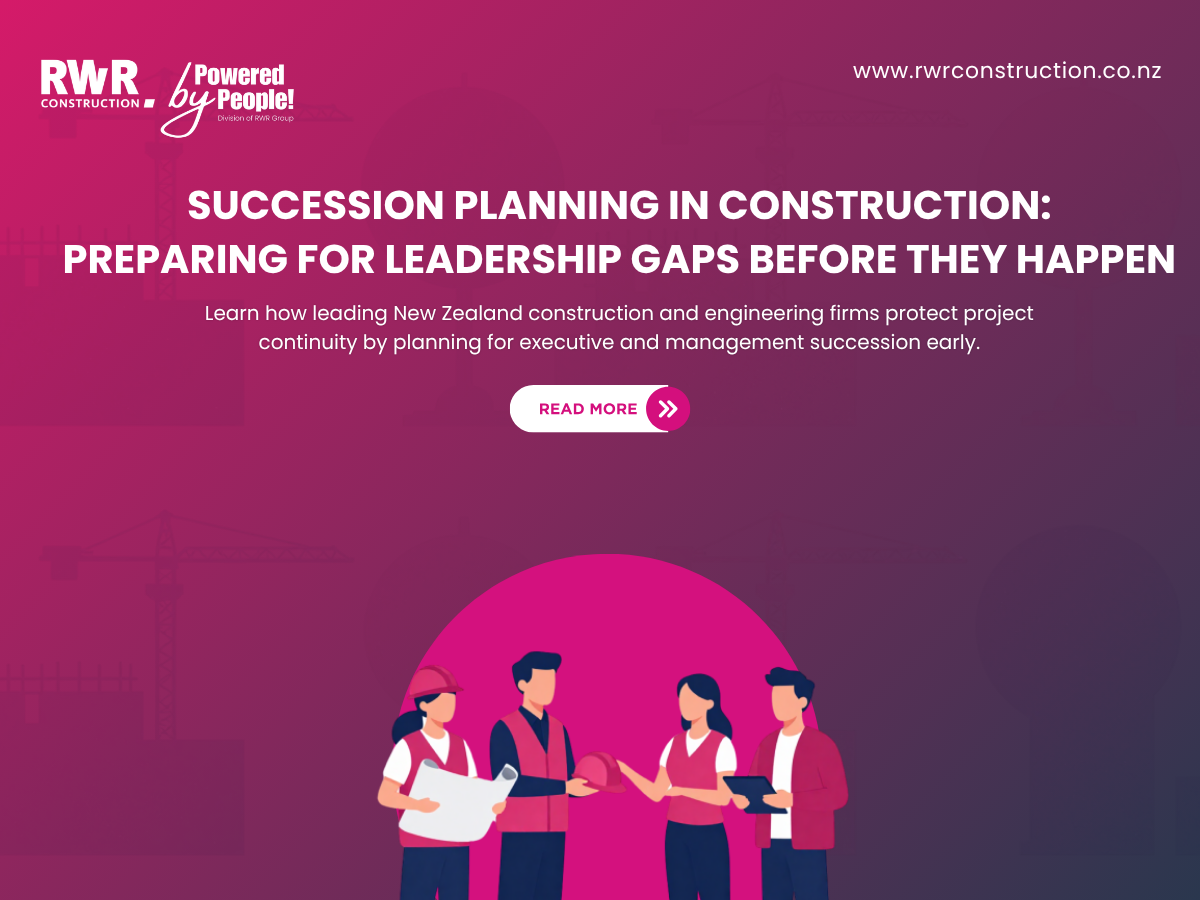
Learn how leading New Zealand construction and engineering firms protect project continuity by planning for executive and management succession early.
By RWR Group Marketing • August 17, 2026
Discover how a precise, commercially focused role brief secures permanent construction and engineering leaders in New Zealand.
By RWR Group Marketing • August 10, 2026
Discover why capability beats out basic tenure when recruiting construction and engineering leaders in New Zealand.
By RWR Group Marketing • August 3, 2026
Learn how to position yourself for permanent construction and engineering management roles earning $100k to $400k+ in New Zealand.
By RWR Group Marketing • July 29, 2026
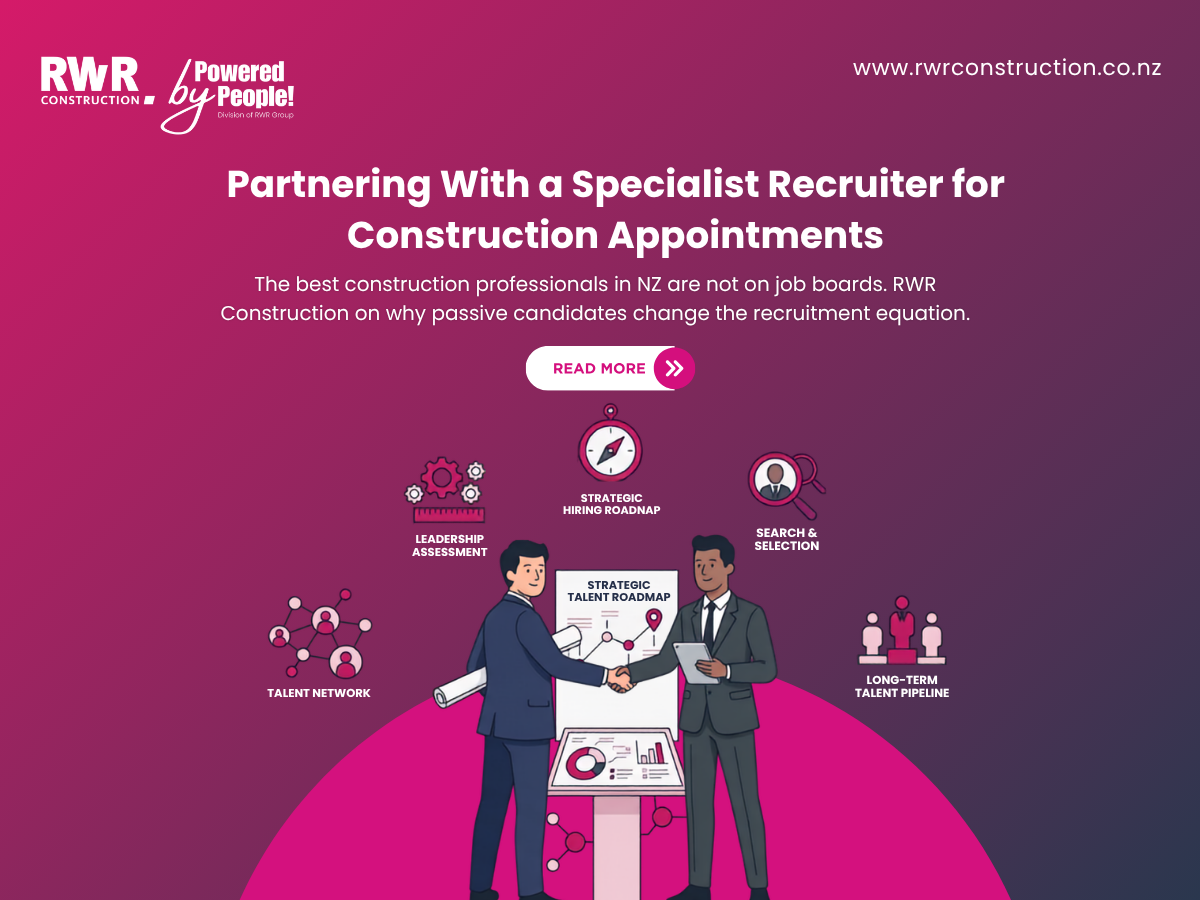
What to look for in a specialist construction recruiter in NZ. How the right recruitment partner changes outcomes for senior and executive appointments.
By RWR Group Marketing • July 27, 2026
The best construction professionals in NZ are not on job boards. RWR Construction on why passive candidates change the recruitment equation.
By RWR Group Marketing • July 20, 2026
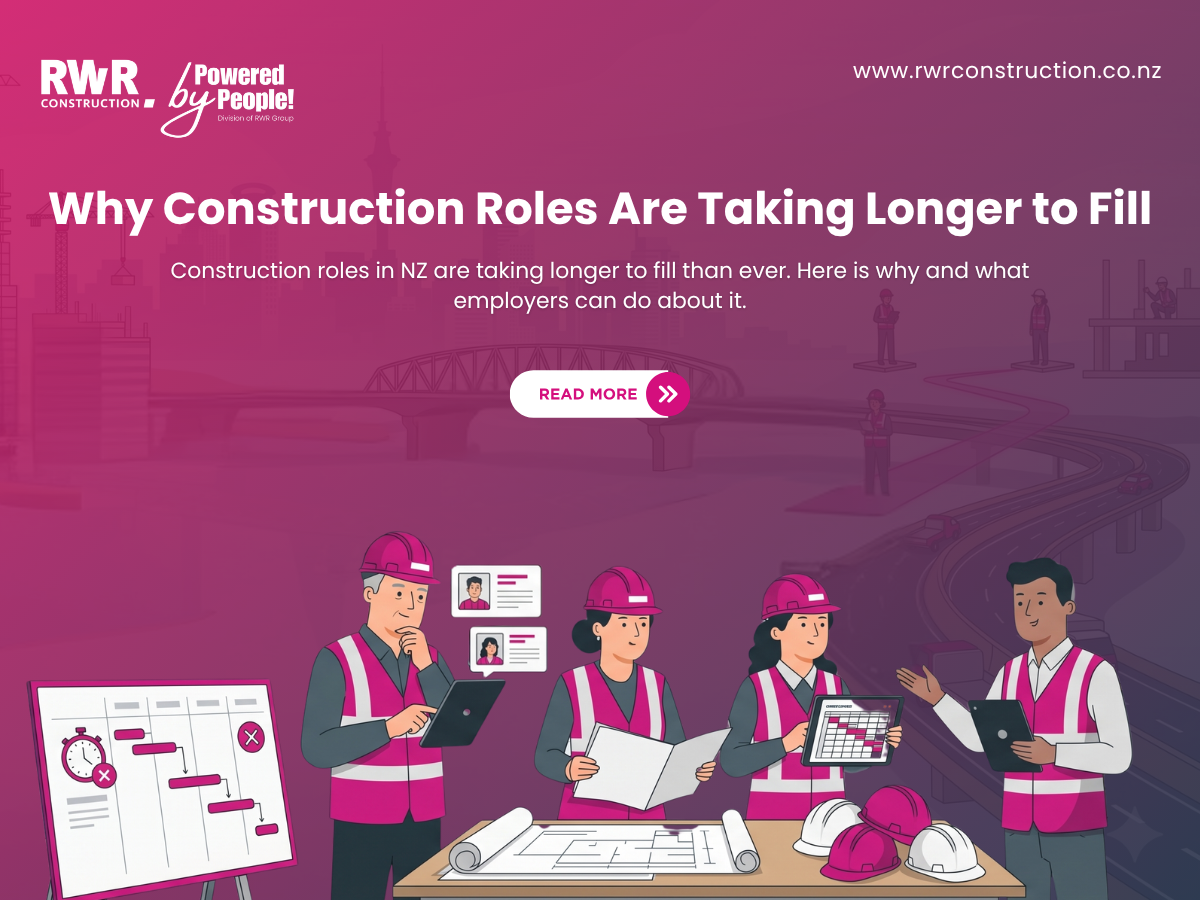
Construction roles in NZ are taking longer to fill than ever. Here is why, and what employers can do about it.