NZ Construction Professionals Moving to Australia

RWR Group Marketing • May 7, 2026

The Tasman has always been a one-way ticket for some. But lately, more senior construction professionals in New Zealand are weighing up the move to Australia.


Strong pipelines in NSW and Queensland, a weaker NZ dollar, and genuine demand for experienced construction leaders are making the proposition hard to ignore. But before you update your CV and start Googling suburbs, it pays to know what you're actually walking into.

What's Driving the Interest

The NZ construction market has had a tough couple of years. Pipeline delays, cost pressures, and a handful of high-profile contractor collapses have left senior professionals questioning their long-term security. Australia, particularly the east coast, is running hard on residential, infrastructure and government-backed civil projects. The remuneration packages are real and the demand for NZ-trained managers is genuine.


What Australia Actually Offers

More volume. More scale. And often, more money. Project Manager roles in Sydney and Brisbane are regularly sitting $20,000 to $50,000 above comparable Auckland packages. For Construction Managers and above, the gap widens further. Superannuation at 12.5% adds another layer that NZ's KiwiSaver doesn't match.


For professionals who have topped out in their current NZ role, Australia can offer the scale of project and complexity of leadership that simply isn't available at home right now.


What People Underestimate

The cost of living. Sydney and Melbourne are expensive cities and the salary uplift can disappear faster than expected once rent, childcare, and lifestyle adjustments are factored in. The market also moves fast. Australian firms are not as patient with recruitment timelines as NZ employers. If you're not ready to commit, you'll lose the role to someone who is.


Licensing and registration requirements differ by state and role. Engineers and project managers may need to navigate additional compliance steps that take time. Going in without a plan costs more than the flight.


How to Do It Right

The professionals who transition successfully don't just send CVs blind. They build a picture of the market first, identify the right company culture, and move with intent. A specialist recruitment partner who operates across both markets is worth their weight. They already know which firms are actually growing, which ones are just posting roles, and what the market will realistically pay you.


QUICK CHECKLIST: BEFORE YOU MOVE

☐ Have you mapped your NZ salary against Australian benchmarks for your specific role and seniority?

☐ Do you understand the licensing and registration requirements in your target state?

☐ Have you spoken to someone who has made the move recently — not five years ago?

☐ Is your CV tailored to Australian market expectations and formatting?

☐ Do you have a recruiter who actually works both markets and has live relationships in the companies you're targeting?


Australia can absolutely be the right move. But it works best when it's planned, not reactive.


If you're seriously considering the Tasman crossing, talk to us first. We work across both markets and can give you a straight read on where your experience sits, what it's worth, and which opportunities are actually worth pursuing.


Visit our Contact Us page or get in touch directly.
By RWR Group Marketing August 3, 2026
Learn how to position yourself for permanent construction and engineering management roles earning $100k to $400k+ in New Zealand.
By RWR Group Marketing July 29, 2026
What to look for in a specialist construction recruiter in NZ. How the right recruitment partner changes outcomes for senior and executive appointments.
By RWR Group Marketing July 27, 2026
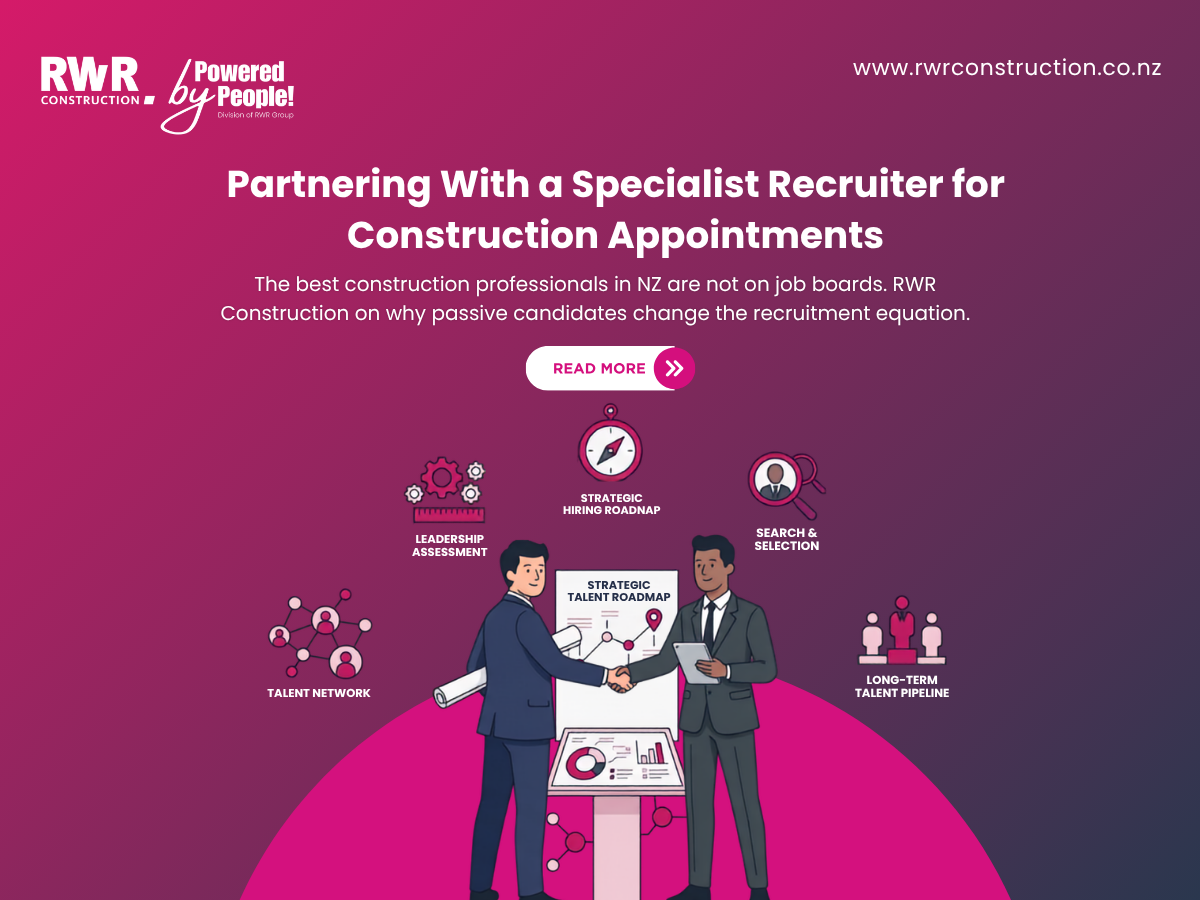
The best construction professionals in NZ are not on job boards. RWR Construction on why passive candidates change the recruitment equation.
By RWR Group Marketing July 20, 2026
Construction roles in NZ are taking longer to fill than ever. Here is why, and what employers can do about it.
By RWR Group Marketing July 14, 2026
Making the move from PM to Construction Director in NZ? Here is what employers are looking for and how to position yourself for the step up.
By RWR Group Marketing June 10, 2026
What do top construction candidates say about working for you? Your employment brand is already out there. Here is how to own it.
By RWR Group Marketing May 14, 2026
BIM, digital delivery and modern methods are reshaping what employers expect from construction leaders. Here's what senior professionals need to know.
By RWR Group Marketing May 1, 2026
In New Zealand construction, hiring needs are shifting as more professionals move between residential and infrastructure projects. While both sectors rely on skilled trades and strong site leadership, the expectations, scale and risk profiles are fundamentally different. Hiring managers who apply the same recruitment approach across both markets often face mismatches, slower onboarding and higher turnover. Understanding the differences is essential for building reliable project teams. Why residential hiring instincts can fail in infrastructure environments Residential construction hiring often prioritises speed, versatility and hands-on problem solving. Candidates are typically expected to move quickly between tasks and adapt to smaller, more fluid teams. Infrastructure roles operate differently. They require structured planning, compliance awareness and the ability to work within layered stakeholder environments. Candidates who thrive in residential settings may struggle with documentation-heavy or process-driven infrastructure projects. When infrastructure candidates expect more structure than residential roles provide Infrastructure professionals are used to clearly defined scopes, reporting lines and regulatory frameworks. When placed into residential environments without that structure, they can experience frustration or disengagement. This mismatch often leads to early exits or underperformance. Clear alignment of expectations is critical before placement. Why speed of hiring means different things in each sector In residential construction, speed is often a competitive advantage. Projects move quickly and hiring decisions are frequently made under time pressure. Infrastructure hiring prioritises accuracy over speed. Compliance checks, safety requirements and long-term project alignment can extend timelines. Rushing this process can lead to costly mis-hires or onboarding delays. Practical checklist for hiring across both construction markets ☐ Define whether the role sits in residential, infrastructure or a hybrid environment ☐ Align job descriptions with the actual project structure and reporting lines ☐ Clarify compliance and certification requirements early in the process ☐ Assess candidates based on sector-specific experience, not general capability alone ☐ Set expectations around pace, documentation and stakeholder involvement 3 hiring adjustments that improve outcomes across both sectors ☐ Separate competency requirements for residential and infrastructure roles instead of using a generic job profile ☐ Adjust interview questions to reflect real site conditions such as compliance demands or project scale ☐ Involve operational leaders from the relevant sector in final hiring decisions Aligning Hiring Strategy With Sector Reality In New Zealand Construction The New Zealand construction market continues to evolve, with many professionals moving between residential builds and large-scale infrastructure projects. However, success in one does not automatically translate to success in the other. Hiring strategies that recognise these differences are more likely to deliver stable teams, stronger project delivery and reduced turnover. RWR Construction supports employers across New Zealand in identifying the right talent for the right environment, ensuring hiring decisions reflect the realities of each sector. Reach out to our team if you want targeted construction recruitment support that can improve your hiring outcomes: Contact Us page . Effective hiring in construction is not about using one consistent playbook. It is about adapting the approach to match the complexity and demands of each project type.
By RWR Group Marketing April 6, 2026
Commercial discipline is reshaping construction recruitment in New Zealand, with employers seeking candidates who demonstrate strong cost awareness, accountability and the ability to deliver long-term project value.
By RWR Group Marketing March 27, 2026
New Zealand’s construction sector is entering a period of cautious recovery. Activity is finally stabilising, particularly across infrastructure and essential housing projects. But here’s the key shift: while project pipelines are returning, skilled talent remains in short supply. This trend isn’t isolated. Australia is experiencing similar conditions, with strong demand for infrastructure and commercial builds placing pressure on an already stretched workforce. For employers across both markets, recruitment is no longer just reactive. Why This Matters As projects ramp up, competition for experienced professionals such as site managers, project managers and skilled trades is intensifying. Businesses that fail to adapt their hiring approach risk project delays, higher costs and burnout within existing teams. 3 Tips to Stay Competitive in Construction Hiring 1. Move Faster Than the Market Top candidates are off the market in a matter of days. Streamline your hiring process to secure talent before competitors do. 2. Offer More Than Just Salary Flexibility, project stability, and career progression are becoming key decision drivers, especially for passive candidates. 3. Think Trans-Tasman With skill shortages in both countries, broadening your search across Australia and New Zealand can unlock new talent pools. Practical Recruitment Checklist ☐ Clear pipeline visibility (6–12 months ahead) ☐ Defined role requirements and timelines ☐ Competitive, up-to-date salary benchmarking ☐ Strong employer value proposition ☐ Efficient interview and decision-making process ☐ Access to passive candidate networks ☐ Workforce retention strategy in place Take Action 1. Review Your Workforce Plan Assess upcoming projects and identify talent gaps early. Waiting until a role is urgent will limit your options. 2. Partner with a Specialist Recruiter Engage experts who understand the construction market and have access to pre-qualified candidates across both New Zealand and Australia. Key Takeaway The construction market is recovering, but the talent shortage hasn’t gone away. Companies that plan ahead, move quickly and position themselves as employers of choice will secure the people they need to deliver projects successfully. Ready to Strengthen Your Team? Scaling up for new projects? Do you need help to replace critical roles? Our team can help you find the right people fast. RWR Construction connects businesses with high-quality construction talent across New Zealand.  Check out these pages on our website for more current talent insights, market updates and recruitment solutions designed to keep your projects moving: Insights