How to Ask Your Current Manager for a Reference

Prakash Singh • February 14, 2025

How to Ask Your Current Manager for a Reference


When you're in the midst of a job search, providing strong references is a key part of the process. References serve as a testament to your work experience, validating the skills and achievements you've highlighted in your resume and during interviews. However, asking your current manager for a reference can be daunting, especially if you haven't yet decided to leave your current role. Here’s how to approach this situation with confidence and respect.


1. Be Clear and Respectful

When asking your current manager for a reference, it’s important to be direct and clear about what you need. Avoid being vague or evasive. Start by expressing your interest in a new opportunity that you believe aligns well with your career goals. Let your manager know that you value the experience and support you’ve received in your current role, but that you feel ready to take on new challenges that will help you grow professionally.

It’s also crucial to clarify that you’re not resigning—you're simply exploring opportunities. This distinction helps prevent any confusion and keeps the conversation focused on your request for a reference.


2. Prepare for Their Response

It’s natural to be unsure of how your manager will react. Some managers may view your request as a loss to the team, while others might see it as an opportunity to help you advance in your career. Be open to their response, whether it’s positive or more reserved.

In some cases, your manager might even offer you new responsibilities or a different role within the company to persuade you to stay. If this happens, consider the offer carefully—could this internal opportunity provide the growth you’re seeking without having to leave the organization?


3. Address Potential Disagreements

If you and your manager don’t always see eye to eye, asking for a reference might feel even more intimidating. However, don’t let this deter you. Just because you’ve had differences doesn’t mean they won’t give you a fair and positive reference. Approach them with honesty, respect, and directness. Explain your intentions clearly, and you might be surprised by their willingness to support your next career move.


4. Don’t Feel Guilty

It’s natural to feel a mix of emotions when considering leaving your current job. Guilt is a common feeling, especially if you have a good relationship with your manager or feel loyal to your team. However, it’s important to remember that your career development is your priority. Your manager understands that employees don’t stay with a company forever, and as long as you’ve been dedicated and hardworking during your tenure, you have no reason to feel bad about seeking new opportunities.


Key Takeaways

  • Be direct and clear: Clearly communicate your intentions and why you’re seeking a reference.
  • Listen to their response: Be open to any feedback or offers they might present.
  • Stay respectful: Even if there have been disagreements, approach your manager with honesty and respect.
  • Focus on your growth: Remember that your career development is important, and it’s okay to move on when the time is right.


Asking your current manager for a reference might feel uncomfortable, but with the right approach, it can be a positive experience. It’s an important step in your job search that can help you secure the role that’s right for you. And remember, your manager’s reference could be the key that opens the door to your next great opportunity.
By RWR Group Marketing July 27, 2026
The best construction professionals in NZ are not on job boards. RWR Construction on why passive candidates change the recruitment equation.
By RWR Group Marketing July 20, 2026
Construction roles in NZ are taking longer to fill than ever. Here is why, and what employers can do about it.
By RWR Group Marketing July 14, 2026
Making the move from PM to Construction Director in NZ? Here is what employers are looking for and how to position yourself for the step up.
By RWR Group Marketing June 10, 2026
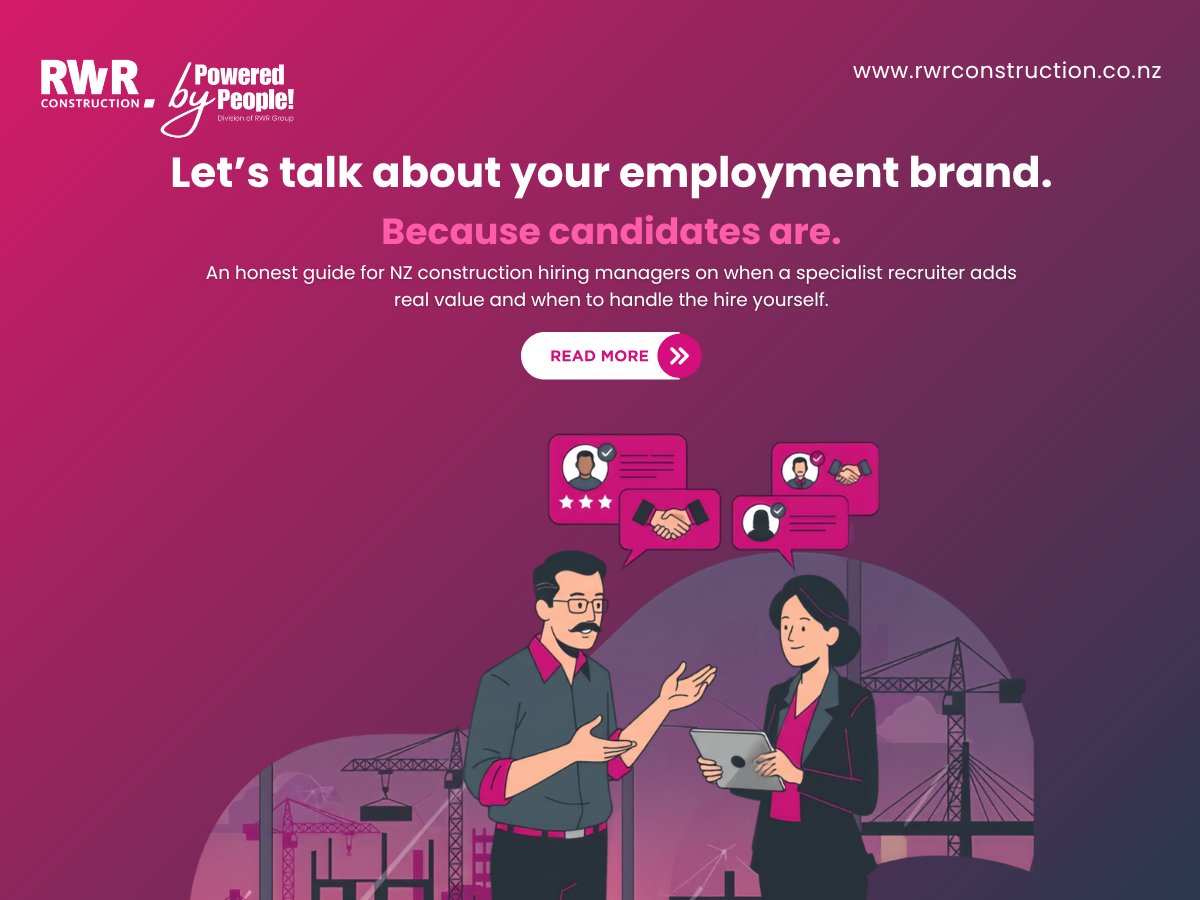
What do top construction candidates say about working for you? Your employment brand is already out there. Here is how to own it.
By RWR Group Marketing May 14, 2026
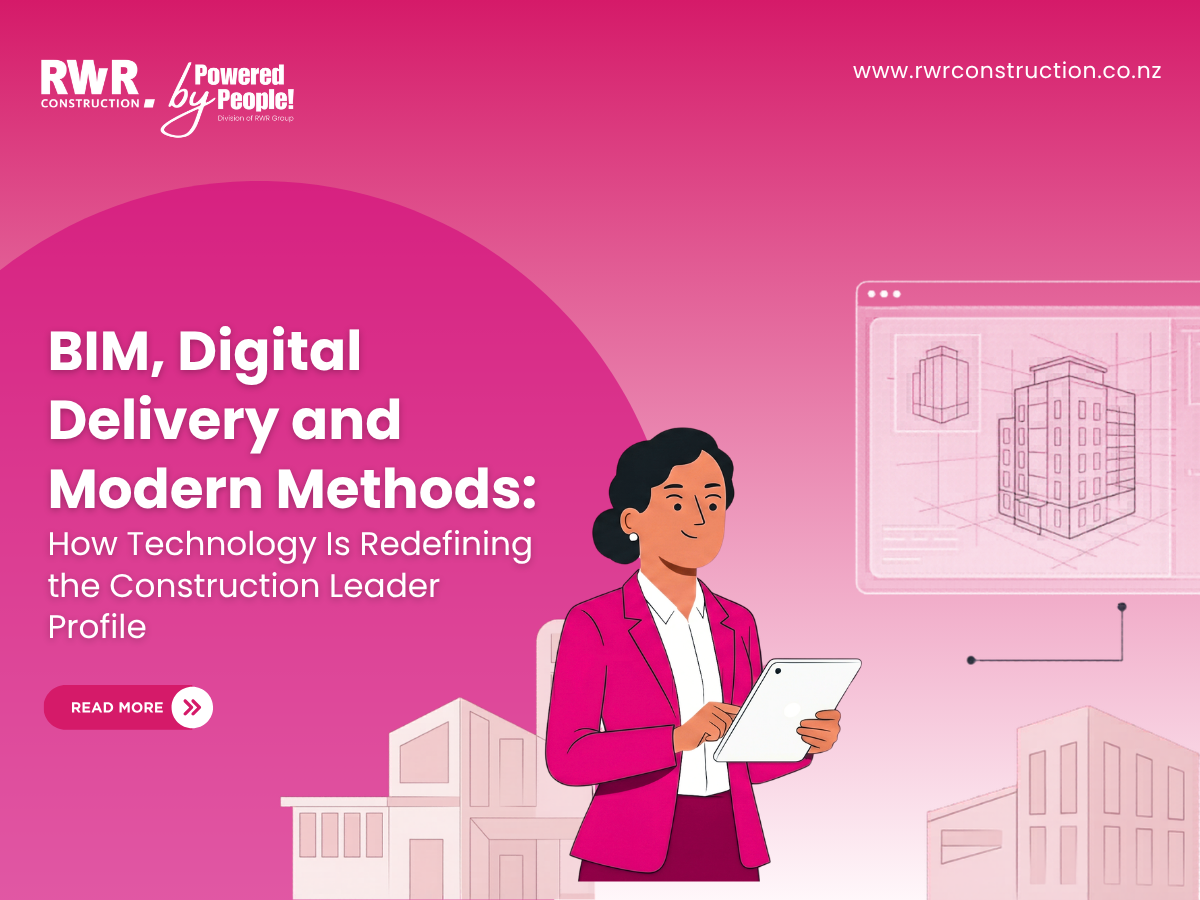
BIM, digital delivery and modern methods are reshaping what employers expect from construction leaders. Here's what senior professionals need to know.
By RWR Group Marketing May 7, 2026
Thinking about crossing the Tasman for a construction role? Here's what senior NZ construction professionals need to know before they make the move.
By RWR Group Marketing May 1, 2026
In New Zealand construction, hiring needs are shifting as more professionals move between residential and infrastructure projects. While both sectors rely on skilled trades and strong site leadership, the expectations, scale and risk profiles are fundamentally different. Hiring managers who apply the same recruitment approach across both markets often face mismatches, slower onboarding and higher turnover. Understanding the differences is essential for building reliable project teams. Why residential hiring instincts can fail in infrastructure environments Residential construction hiring often prioritises speed, versatility and hands-on problem solving. Candidates are typically expected to move quickly between tasks and adapt to smaller, more fluid teams. Infrastructure roles operate differently. They require structured planning, compliance awareness and the ability to work within layered stakeholder environments. Candidates who thrive in residential settings may struggle with documentation-heavy or process-driven infrastructure projects. When infrastructure candidates expect more structure than residential roles provide Infrastructure professionals are used to clearly defined scopes, reporting lines and regulatory frameworks. When placed into residential environments without that structure, they can experience frustration or disengagement. This mismatch often leads to early exits or underperformance. Clear alignment of expectations is critical before placement. Why speed of hiring means different things in each sector In residential construction, speed is often a competitive advantage. Projects move quickly and hiring decisions are frequently made under time pressure. Infrastructure hiring prioritises accuracy over speed. Compliance checks, safety requirements and long-term project alignment can extend timelines. Rushing this process can lead to costly mis-hires or onboarding delays. Practical checklist for hiring across both construction markets ☐ Define whether the role sits in residential, infrastructure or a hybrid environment ☐ Align job descriptions with the actual project structure and reporting lines ☐ Clarify compliance and certification requirements early in the process ☐ Assess candidates based on sector-specific experience, not general capability alone ☐ Set expectations around pace, documentation and stakeholder involvement 3 hiring adjustments that improve outcomes across both sectors ☐ Separate competency requirements for residential and infrastructure roles instead of using a generic job profile ☐ Adjust interview questions to reflect real site conditions such as compliance demands or project scale ☐ Involve operational leaders from the relevant sector in final hiring decisions Aligning Hiring Strategy With Sector Reality In New Zealand Construction The New Zealand construction market continues to evolve, with many professionals moving between residential builds and large-scale infrastructure projects. However, success in one does not automatically translate to success in the other. Hiring strategies that recognise these differences are more likely to deliver stable teams, stronger project delivery and reduced turnover. RWR Construction supports employers across New Zealand in identifying the right talent for the right environment, ensuring hiring decisions reflect the realities of each sector. Reach out to our team if you want targeted construction recruitment support that can improve your hiring outcomes: Contact Us page . Effective hiring in construction is not about using one consistent playbook. It is about adapting the approach to match the complexity and demands of each project type.
By RWR Group Marketing April 6, 2026
Commercial discipline is reshaping construction recruitment in New Zealand, with employers seeking candidates who demonstrate strong cost awareness, accountability and the ability to deliver long-term project value.
By RWR Group Marketing March 27, 2026
New Zealand’s construction sector is entering a period of cautious recovery. Activity is finally stabilising, particularly across infrastructure and essential housing projects. But here’s the key shift: while project pipelines are returning, skilled talent remains in short supply. This trend isn’t isolated. Australia is experiencing similar conditions, with strong demand for infrastructure and commercial builds placing pressure on an already stretched workforce. For employers across both markets, recruitment is no longer just reactive. Why This Matters As projects ramp up, competition for experienced professionals such as site managers, project managers and skilled trades is intensifying. Businesses that fail to adapt their hiring approach risk project delays, higher costs and burnout within existing teams. 3 Tips to Stay Competitive in Construction Hiring 1. Move Faster Than the Market Top candidates are off the market in a matter of days. Streamline your hiring process to secure talent before competitors do. 2. Offer More Than Just Salary Flexibility, project stability, and career progression are becoming key decision drivers, especially for passive candidates. 3. Think Trans-Tasman With skill shortages in both countries, broadening your search across Australia and New Zealand can unlock new talent pools. Practical Recruitment Checklist ☐ Clear pipeline visibility (6–12 months ahead) ☐ Defined role requirements and timelines ☐ Competitive, up-to-date salary benchmarking ☐ Strong employer value proposition ☐ Efficient interview and decision-making process ☐ Access to passive candidate networks ☐ Workforce retention strategy in place Take Action 1. Review Your Workforce Plan Assess upcoming projects and identify talent gaps early. Waiting until a role is urgent will limit your options. 2. Partner with a Specialist Recruiter Engage experts who understand the construction market and have access to pre-qualified candidates across both New Zealand and Australia. Key Takeaway The construction market is recovering, but the talent shortage hasn’t gone away. Companies that plan ahead, move quickly and position themselves as employers of choice will secure the people they need to deliver projects successfully. Ready to Strengthen Your Team? Scaling up for new projects? Do you need help to replace critical roles? Our team can help you find the right people fast. RWR Construction connects businesses with high-quality construction talent across New Zealand.  Check out these pages on our website for more current talent insights, market updates and recruitment solutions designed to keep your projects moving: Insights
By RWR Group Marketing March 19, 2026
In a tight labour market, strong leadership is the key to reducing hiring risk and building resilient teams. Discover how effective leaders improve recruitment outcomes, retention and long-term business success.