BIM, digital delivery and modern methods are reshaping what employers expect from construction leaders. Here's what senior professionals need to know.

RWR Group Marketing • May 14, 2026

Ten years ago, a Construction Manager who could read drawings, manage a programme and hold a subcontractor to account was everything a client needed. That baseline still matters, but the job description has shifted significantly.


The gap between professionals who have kept pace with technology and those who haven't is showing up in shortlists.


What Employers Are Actually Asking For Now

BIM is no longer a differentiator. It's an expectation on any significant project. Employers in commercial, civil and infrastructure are asking about digital delivery experience at first interview. Not because they want someone to run the software, but because they want leaders who understand how digital tools change workflow, coordination and risk management across a project.


Programme management tools, digital site safety systems and data-led reporting are appearing on briefs for Project Manager and Construction Manager roles that would have been purely operationally-focused five years ago.

The Skills That Are Genuinely Valued

There is a distinction worth making. Employers are not looking for technology specialists in operational leadership roles. They are looking for digitally fluent leaders who can engage with BIM coordinators, interrogate data outputs and make informed decisions based on digital information rather than defaulting to paper-based instinct.


Modern Methods of Construction, offsite, modular and prefabrication, are creating demand for professionals who understand both traditional build and manufactured components. This is a specific and currently undersupplied skill set in New Zealand.


What This Means For Your Career

If you are mid-career and your technology exposure has been limited by the projects you have worked on rather than by lack of interest, the gap is closeable. A short-form BIM course, a secondment to a digitally-led project, or even a structured conversation with your current employer about digital upskilling can move the needle.


The professionals landing the best roles right now are not the most tech-savvy in the room. They are the ones who can lead people and projects AND communicate credibly about digital delivery. That combination is rare and well-compensated.


KEY FACTS: TECHNOLOGY AND THE NZ CONSTRUCTION LEADERSHIP MARKET

  • BIM proficiency is now mentioned in over 60% of mid to senior construction management briefs in NZ.
  • Modern Methods of Construction experience adds an average 10-15% salary premium for roles with offsite or modular scope.
  • Digital site safety and programme management tool competency is increasingly standard at Project Manager level and above.
  • Employers consistently report that digital fluency, not mastery, is what separates shortlisted candidates.


Technology is not replacing construction leaders. It is raising the floor on what a strong leader looks like. The professionals who understand this are positioning themselves well.


If you want an honest read on where your profile sits against current market expectations, and what gaps are worth closing, get in touch. That is exactly the kind of conversation we have every week.


Visit our Jobs page if you're currently open to new opportunities in the construction industry. 

By RWR Group Marketing August 10, 2026
Discover why capability beats out basic tenure when recruiting construction and engineering leaders in New Zealand.
By RWR Group Marketing August 3, 2026
Learn how to position yourself for permanent construction and engineering management roles earning $100k to $400k+ in New Zealand.
By RWR Group Marketing July 29, 2026
What to look for in a specialist construction recruiter in NZ. How the right recruitment partner changes outcomes for senior and executive appointments.
By RWR Group Marketing July 27, 2026
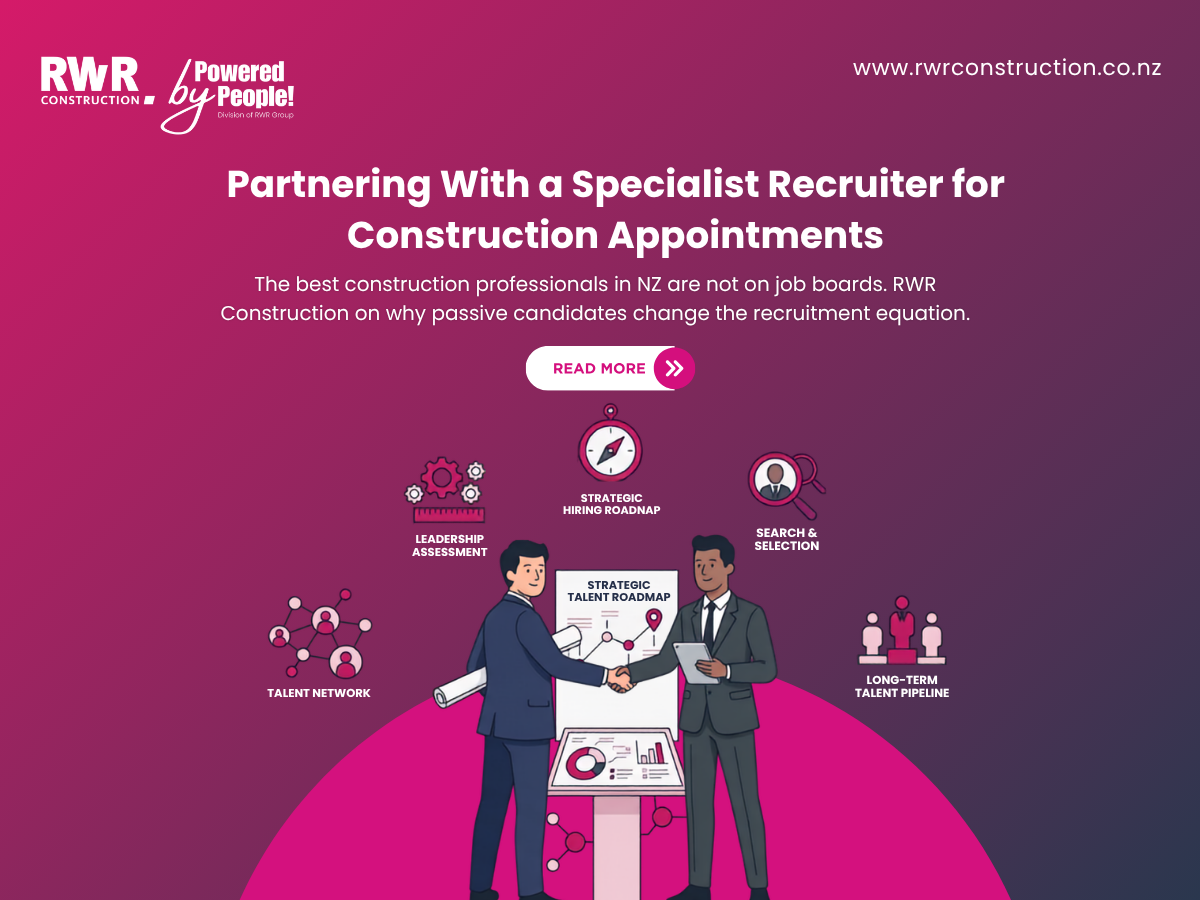
The best construction professionals in NZ are not on job boards. RWR Construction on why passive candidates change the recruitment equation.
By RWR Group Marketing July 20, 2026
Construction roles in NZ are taking longer to fill than ever. Here is why, and what employers can do about it.
By RWR Group Marketing July 14, 2026
Making the move from PM to Construction Director in NZ? Here is what employers are looking for and how to position yourself for the step up.
By RWR Group Marketing June 10, 2026
What do top construction candidates say about working for you? Your employment brand is already out there. Here is how to own it.
By RWR Group Marketing May 7, 2026
Thinking about crossing the Tasman for a construction role? Here's what senior NZ construction professionals need to know before they make the move.
By RWR Group Marketing May 1, 2026
In New Zealand construction, hiring needs are shifting as more professionals move between residential and infrastructure projects. While both sectors rely on skilled trades and strong site leadership, the expectations, scale and risk profiles are fundamentally different. Hiring managers who apply the same recruitment approach across both markets often face mismatches, slower onboarding and higher turnover. Understanding the differences is essential for building reliable project teams. Why residential hiring instincts can fail in infrastructure environments Residential construction hiring often prioritises speed, versatility and hands-on problem solving. Candidates are typically expected to move quickly between tasks and adapt to smaller, more fluid teams. Infrastructure roles operate differently. They require structured planning, compliance awareness and the ability to work within layered stakeholder environments. Candidates who thrive in residential settings may struggle with documentation-heavy or process-driven infrastructure projects. When infrastructure candidates expect more structure than residential roles provide Infrastructure professionals are used to clearly defined scopes, reporting lines and regulatory frameworks. When placed into residential environments without that structure, they can experience frustration or disengagement. This mismatch often leads to early exits or underperformance. Clear alignment of expectations is critical before placement. Why speed of hiring means different things in each sector In residential construction, speed is often a competitive advantage. Projects move quickly and hiring decisions are frequently made under time pressure. Infrastructure hiring prioritises accuracy over speed. Compliance checks, safety requirements and long-term project alignment can extend timelines. Rushing this process can lead to costly mis-hires or onboarding delays. Practical checklist for hiring across both construction markets ☐ Define whether the role sits in residential, infrastructure or a hybrid environment ☐ Align job descriptions with the actual project structure and reporting lines ☐ Clarify compliance and certification requirements early in the process ☐ Assess candidates based on sector-specific experience, not general capability alone ☐ Set expectations around pace, documentation and stakeholder involvement 3 hiring adjustments that improve outcomes across both sectors ☐ Separate competency requirements for residential and infrastructure roles instead of using a generic job profile ☐ Adjust interview questions to reflect real site conditions such as compliance demands or project scale ☐ Involve operational leaders from the relevant sector in final hiring decisions Aligning Hiring Strategy With Sector Reality In New Zealand Construction The New Zealand construction market continues to evolve, with many professionals moving between residential builds and large-scale infrastructure projects. However, success in one does not automatically translate to success in the other. Hiring strategies that recognise these differences are more likely to deliver stable teams, stronger project delivery and reduced turnover. RWR Construction supports employers across New Zealand in identifying the right talent for the right environment, ensuring hiring decisions reflect the realities of each sector. Reach out to our team if you want targeted construction recruitment support that can improve your hiring outcomes: Contact Us page . Effective hiring in construction is not about using one consistent playbook. It is about adapting the approach to match the complexity and demands of each project type.
By RWR Group Marketing April 6, 2026
Commercial discipline is reshaping construction recruitment in New Zealand, with employers seeking candidates who demonstrate strong cost awareness, accountability and the ability to deliver long-term project value.