The Hidden Costs of Employee Turnover and How to Mitigate Them

RWR Group Marketing • August 21, 2024

The Hidden Costs of Employee Turnover

Employee turnover is more than just a challenge—it's a significant cost to businesses that often goes uncalculated. While many companies focus on the expenses associated with recruiting and training new hires, the true cost of losing an employee is far more complex. For businesses in the construction industry, where expertise and experience are critical, understanding and addressing these costs is essential.


The Financial Impact of Employee Turnover

Replacing an employee isn’t just about hiring a new one; it's about the total cost involved in the process. In the U.S., businesses spend between 50% to 60% of an employee’s annual salary to find a replacement. In some cases, this can even reach up to 200%. The situation is no different in New Zealand, where employee turnover has cost businesses a staggering $3.8 billion over a 12-month period.

These numbers underline a critical point: high employee turnover is an expensive problem that spans industries. From lost productivity to the impact on company culture, the hidden costs of turnover can significantly affect a business’s bottom line.


Key Reasons Behind High Employee Turnover

Understanding why employees leave is crucial in mitigating turnover. Studies show that the first 45 days of employment are the most critical, with up to 20% of new hires leaving during this period. The reasons for this early departure are varied:

  1. Mismatch of Expectations: Often, the job is oversold during recruitment, leading to disappointment.
  2. Poor Onboarding: An ineffective onboarding process can shake a new hire's confidence in the company.
  3. Lack of Clarity: Unclear job duties and expectations can leave employees feeling lost and unsupported.
  4. Management Issues: Poor management, including micromanaging or unprepared managers, is a common reason employees leave.
  5. Limited Growth Opportunities: Employees need to see a clear path for growth within the company.
  6. Infrequent Feedback: Regular check-ins are essential to keep employees engaged and aligned with company goals.
  7. Rigid Workplace Policies: A lack of work-life balance or a hostile work environment can drive employees away.
  8. Inadequate Support: Employees need to feel supported by their organization, both personally and professionally.

Even beyond the initial phase, turnover remains a risk, with nearly a quarter of new employees leaving within their first year. This highlights the importance of consistent and long-term engagement from both HR and management.


Breaking Down the Costs of Turnover

The costs associated with turnover can be categorized into six main areas:


  1. Replacement Time: It can take 8-12 weeks to replace a knowledge worker and even longer for more senior roles. During this time, productivity suffers.
  2. Training Costs: Training new hires is costly, involving not just the trainee but also the trainer and their manager, often the company’s most efficient employees.
  3. Lost Productivity: Frequent turnover negatively impacts morale and productivity, with new hires taking 6 to 9 months to reach full productivity.
  4. Cultural Impact: High turnover can erode company culture and lower morale, affecting how long remaining employees plan to stay.
  5. Higher Costs for External Hires: External hires often demand higher salaries, which can create wage disparities within the company.
  6. Client Relationship Impact: High turnover can disrupt client relationships, leading to lost business and compromised timelines.

Steps to Reduce Employee Turnover

Reducing turnover begins with recognizing its full cost. By aligning turnover issues with business metrics, companies can better understand the impact and take action.


Step 1: Awareness and Alignment

Educate your team about the costs of turnover and ensure that these are tied to real business metrics. This will foster a sense of responsibility to hire well and retain employees.


Step 2: Build a Strong Onboarding Program

An effective onboarding program is key to employee retention. Make sure new hires feel welcomed and supported from the moment they sign their contract through their first six months.


Step 3: Innovate and Automate

Consider implementing an automated onboarding process to streamline administration and ensure consistency in how new employees are integrated into your organization.


Step 4. Exit Interviews Seek to understand why employees are leaving your business, collate the data and look for common themes, address any issues to reduce staff turnover. 


By focusing on these areas, you can mitigate the hidden costs of employee turnover, creating a more stable and productive workforce.


Have you seen our Ultimate Recruitment Guide?


Data Source: https://action.deloitte.com/

By RWR Group Marketing • September 27, 2026
Technical brilliance won't save a project if the relationships around it fall apart. That's the reality of leadership. Every major project in New Zealand runs on relationships. Clients, consultants, contractors and subcontractors all need to move in the same direction, often with different priorities and different pressures. Leadership at the top holds it together, or lets it fall apart. Here's what separates leaders who manage these relationships well from those who don't. Clarity over comfort Strong relationship managers don't avoid hard conversations. They have them early, clearly and respectfully. Leaders who dodge difficult topics to keep the peace tend to store up bigger problems for later. Look for candidates who can demonstrate direct, respectful communic ation under pressure. Genuine stakeholder management, not just reporting There's a big difference between updating a client and managing a client. The best understand what each stakeholder needs, not just what they say they need, and adjust their approach accordingly. That takes judgement, not just a status report template. Consistency across every relationship A leader who's warm with clients but dismissive with subcontractors is building a fragile network. Look for candidates who treat every relationship, client, consultant or contractor, with the same level of respect and professionalism. It shows up in team culture and in project outcomes. Commercial awareness in every conversation Every relationship in construction has a commercial dimension. Strong leaders understand this and negotiate accordingly, protecting margin and programme without damaging trust. Ask candidates how they've handled a commercial disagreement with a client or consultant. Their answer will reveal how they balance relationship and result. Proven conflict resolution Disagreements are inevitable on complex projects. What matters is how quickly and how well they get resolved. Ask for specific examples. A leader who can describe how they turned a tense client relationship around is showing you exactly what you need to see. Checklist for your next appointment ☐ Can they demonstrate clear communication under pressure? ☐ Have they genuinely managed stakeholders, not just reported to them? ☐ Are they consistent across every relationship type? ☐ Can they balance commercial outcomes with trust? ☐ Do they have an example of resolving conflict well? The strength of your leadership team shows up first in the strength of its relationships. At RWR Construction, we place permanent leaders across New Zealand's construction, engineering and infrastructure sectors who know how to manage every relationship a project depends on. Looking for a leader who can hold it all together? Visit www.rwrconstruction.co.nz/contact-us
By RWR Group Marketing • September 23, 2026
Your business today won't be the same in three years. So why hire leaders who can only handle where you are right now? Across New Zealand's construction, engineering and infrastructure sectors, growth is rarely steady. It comes in bursts: new contracts, new regions, new scale. The leaders you appoint today need to grow with that.. Here's what to look for when hiring for scale, not just for now Look past the current job description. Most businesses hire for the role in front of them. The smarter move is hiring for the role the business will need in eighteen months. Ask candidates how they'd approach the job if headcount doubled, or if the business moved into a new region. Their answer tells you more than their CV ever will. Test adaptability, not just experience Experience shows what someone has done. It doesn't show what they can do next. Look for leaders who've operated across different business sizes, structures or sectors. That range often predicts scalability better than years in a single role. Prioritise systems thinking Leaders who scale well think in systems, not just tasks. They build processes that don't rely on them being in the room. Ask candidates how they've set up teams, reporting lines or handover processes in past roles. If they can only describe their own workload, that's a red flag. Look for people who build people A leader who can scale with your business is one who grows other leaders underneath them. Ask about who they've mentored, promoted or backed. A strong bench is one of the clearest signs of leadership built for growth. Assess how they handle ambiguity Growing businesses rarely have everything mapped out. Leaders who need certainty before they act will slow you down exactly when you need speed. Look for calm decision-making in the face of incomplete information. It's a strong indicator of how they'll perform as the business scales. Key takeaways Hire for where the business is going, not just where it is Test adaptability and systems thinking, not only technical experience Look for leaders who develop other leaders Prioritise calm decision-making under ambiguity Growth is the goal. The right leadership is what makes it sustainable. At RWR Construction, we specialise in placing permanent leaders across New Zealand's construction, engineering and infrastructure sectors- people who can grow with your business, not just fill today's gap. Ready to hire for the business you're building? Visit www.rwrconstruction.co.nz/contact-us
By RWR Group Marketing • September 19, 2026
You've got the resume. You've got the runs on the board. So why does the right role still feel out of reach? In New Zealand's construction, engineering and infrastructure sectors, hiring has changed. Employers aren't just filling seats. They're building teams that can carry a business through growth, risk and change. If you're aiming for a leadership or role, here's what's landing on the shortlist. Commercial judgement, not just technical skill Technical competence gets you in the room. It doesn't get you the job. Employers want leaders who understand margin, risk and programme in the same breath. They want people who can read a P&L as confidently as they read a set of drawings. If you can talk numbers and outcomes, not just delivery, you stand out immediately. Proof of leading through pressure - every construction business has a project that went sideways. Employers want to know how you handled it. Did you keep the client onside? Did you protect the team? Did you find a way through without losing your head or your credibility? Stories beat rehearsed answers every time. Cultural fit that goes both ways. Hiring is rarely just about credentials. It's about whether you'll fit the culture, and whether the culture will bring out your best work. Employers are looking harder at how candidates communicate, how they handle feedback, and how they show up under pressure. Be honest about what environment helps you thrive. It saves everyone time. Evidence of scalability Can you grow with the business? That's the question behind most interviews. Employers want leaders who've shown they can step up as a company grows, not just manage what already exists. Talk about the moments you took on more responsibility and delivered. A track record of managing relationships, not just projects Clients, consultants, subcontractors, regulators. Construction roles are relationship-heavy. Employers want to see you've built trust across all of these, not just delivered the physical build. If you've managed a difficult client relationship to a good outcome, that story matters more than another technical achievement. Quick self-check before your next interview Can you explain a project's commercial outcome, not just its physical outcome? Do you have a clear, honest story about a project under pressure? Can you show how you've grown into bigger responsibility over time? Can you point to relationships you've built and protected, not just projects you've delivered? If you ticked most of those, you're closer than you think.  The right opportunity is about fit as much as experience. At RWR Construction, we work with New Zealand's construction, engineering and infrastructure leaders to match genuine capability with genuine opportunity. Ready for your next move? Visit www.rwrconstruction.co.nz/contact-us and let's talk about where you fit.
By RWR Group Marketing • August 24, 2026
Learn how leading New Zealand construction and engineering firms protect project continuity by planning for executive and management succession early.
By RWR Group Marketing • August 17, 2026
Discover how a precise, commercially focused role brief secures permanent construction and engineering leaders in New Zealand.
By RWR Group Marketing • August 10, 2026
Discover why capability beats out basic tenure when recruiting construction and engineering leaders in New Zealand.
By RWR Group Marketing • August 3, 2026
Learn how to position yourself for permanent construction and engineering management roles earning $100k to $400k+ in New Zealand.
By RWR Group Marketing • July 29, 2026
What to look for in a specialist construction recruiter in NZ. How the right recruitment partner changes outcomes for senior and executive appointments.
By RWR Group Marketing • July 27, 2026
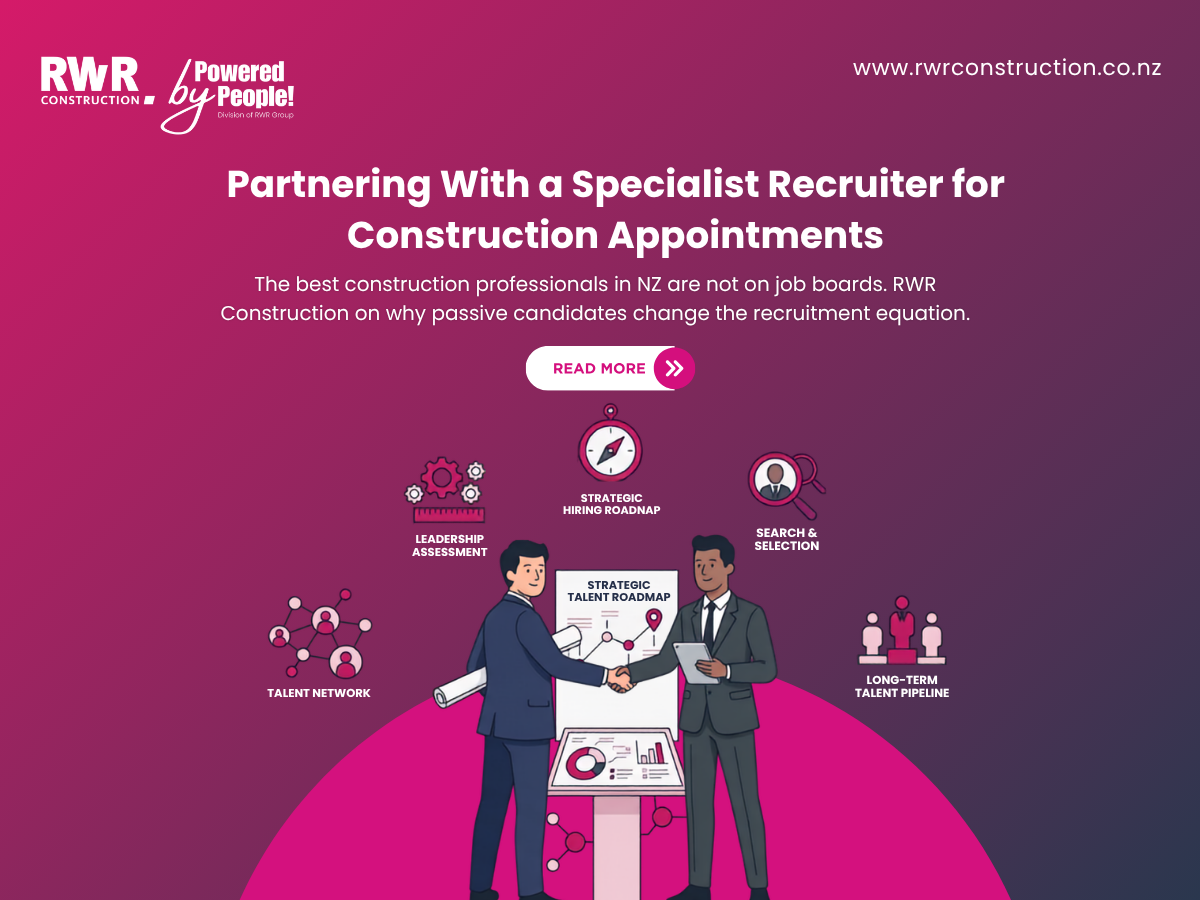
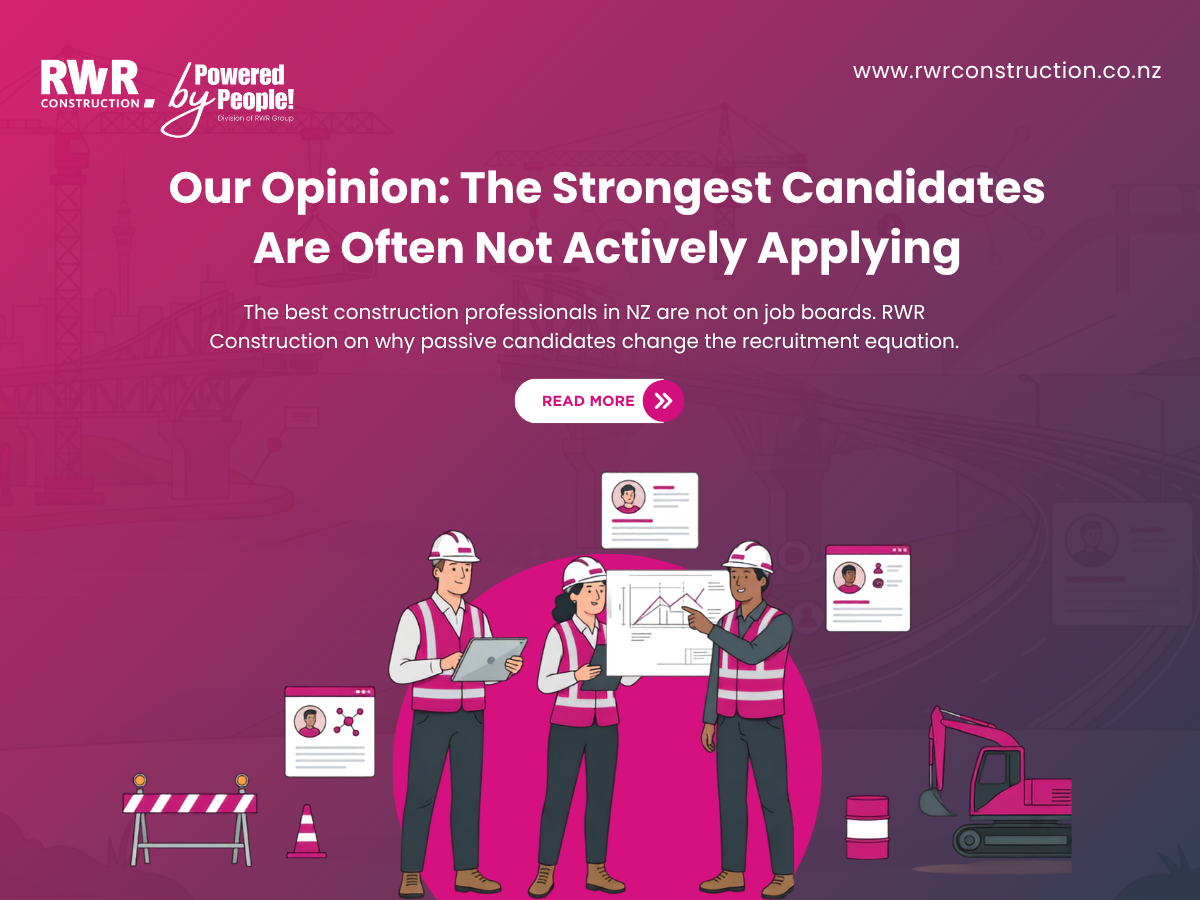
The best construction professionals in NZ are not on job boards. RWR Construction on why passive candidates change the recruitment equation.
By RWR Group Marketing • July 20, 2026
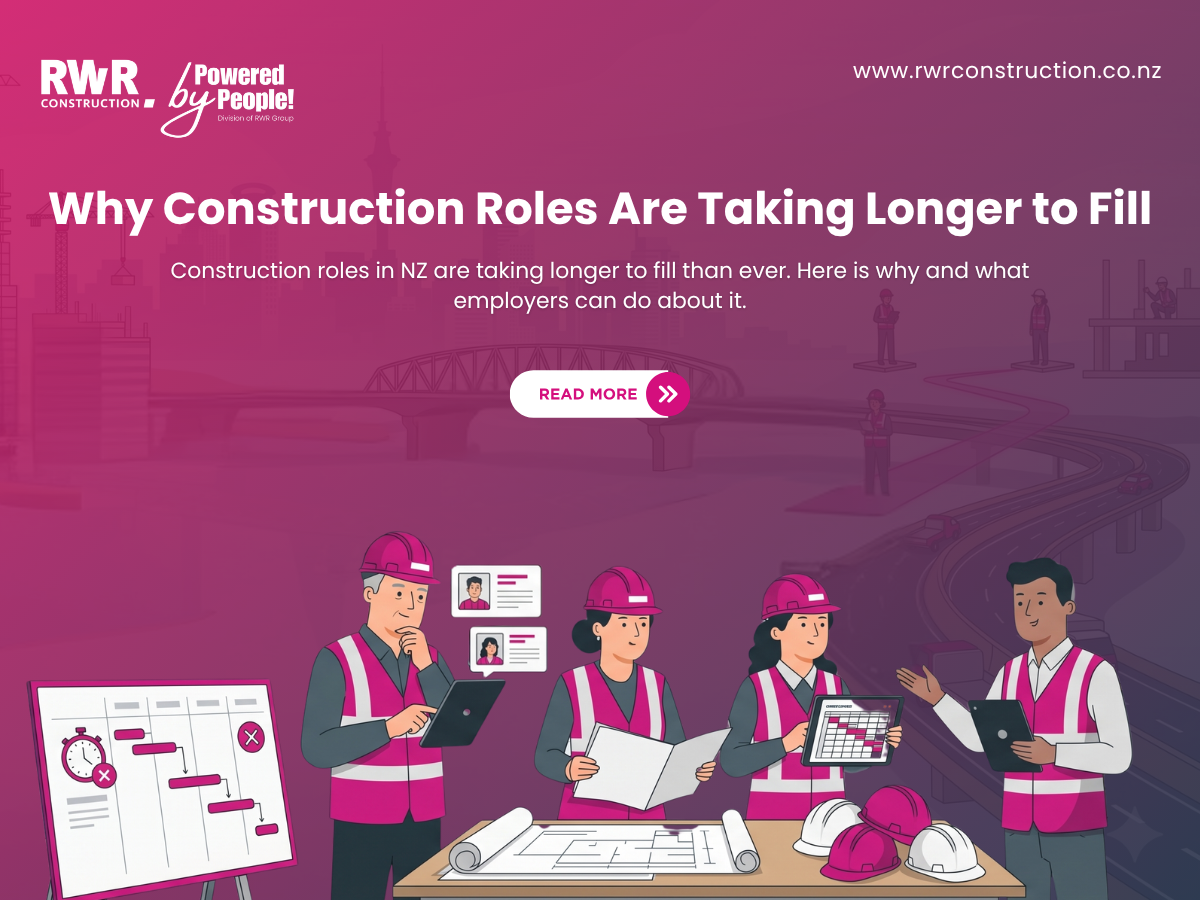
Construction roles in NZ are taking longer to fill than ever. Here is why, and what employers can do about it.